
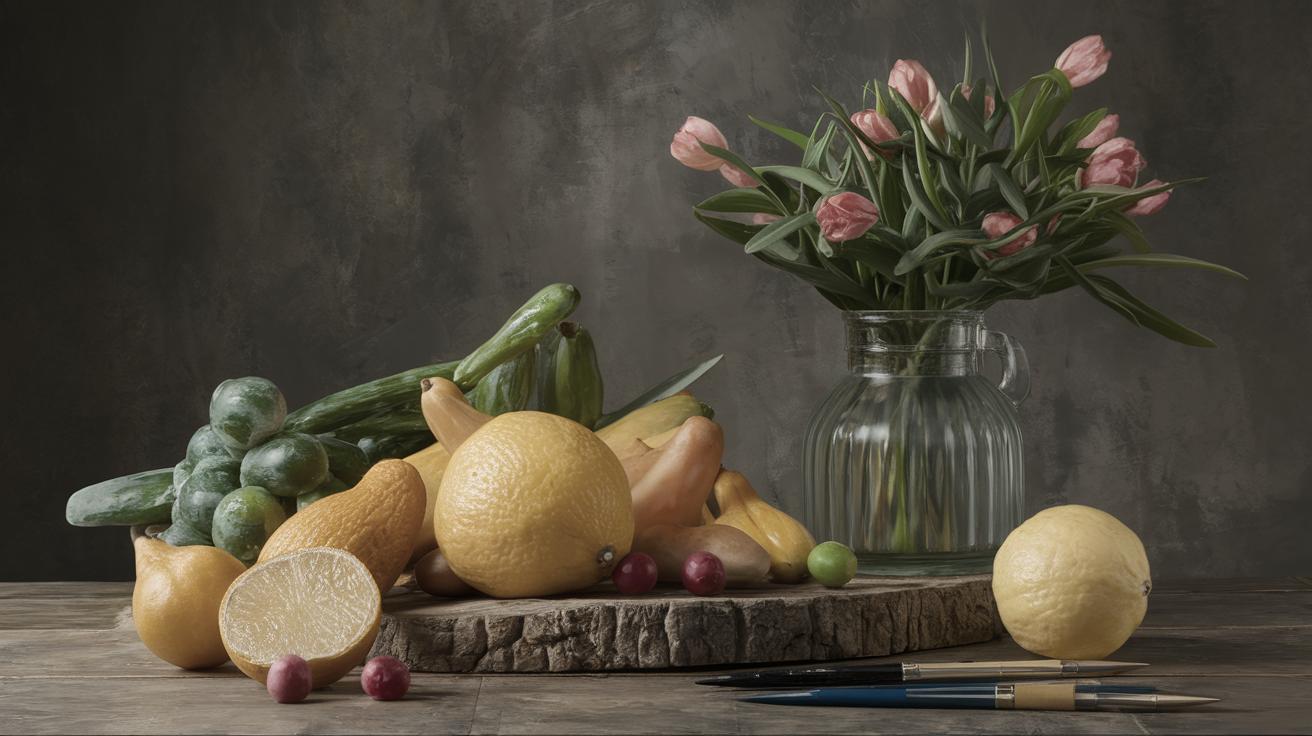
Exploring Still Life Photo References
Still life photography is an art form that celebrates the beauty of objects, their interactions with light, and the stories they tell. In this blog post, we delve into the multifaceted world of photographic references across various subjects and techniques. From still life compositions to landscapes, reflective objects, and portraiture, each section offers insights into capturing the essence of different genres. We’ll explore the significance of white backgrounds and wooden blocks in watercolor exercises and value training, and discuss the role of colored spheres in honing your understanding of color and form. These references serve as invaluable tools for artists and photographers, providing endless inspiration and opportunities for experimentation.
Still Life Photo References
Still life photographs are a foundational element in artistic practice, offering rich insights into composition, lighting, and texture. These images capture everyday objects in meticulous detail, allowing artists to study the interplay of shapes and shadows. Whether it’s a bowl of fruit, a collection of vintage items, or a simple vase of flowers, still life references are ideal for understanding how to create balanced and visually engaging compositions.
One of the key benefits of using still life as a photo reference is its versatility. Unlike other subjects that may require specific environments or timing, still life setups can be easily controlled and adjusted. This enables artists to explore various angles, light sources, and object arrangements, providing a perfect platform to experiment with creativity and hone technical skills.
Additionally, still life photography encourages a deeper appreciation for the often-overlooked beauty in everyday things. By focusing on simple objects and transforming them into subjects of artistic inspiration, photographers and artists can develop a keen eye for detail and a greater ability to convey narrative through imagery.
Landscape References
Landscape photography references are essential for artists aiming to capture the grandeur and subtle nuances of natural environments. These images offer a window into the diverse tapestry of the natural world, from expansive mountainscapes to serene seascapes. By studying these references, artists can enhance their understanding of composition, perspective, and light, enabling them to recreate the atmosphere and emotion of a scene.
A well-chosen landscape photo reference provides insights into how natural light interacts with the environment, highlighting features such as trees, water bodies, and skies. Artists can experiment with these elements, exploring how they convey mood, depth, and texture. These references also help in studying how weather conditions and times of day influence the overall tone and feel of a landscape.
Furthermore, landscape references encourage artists to capture the essence of a place and tell stories through their work. This challenges them to go beyond mere representation and explore the broader context and cultural significance of the locations they depict.
Reflective References
Reflective surfaces in photography present a unique challenge due to their ability to alter and manipulate light. These surfaces, found in objects like glass, water, and metals, add a dynamic dimension to compositions, and studying them can greatly enhance an artist’s skill in handling reflections and highlights.
Photo references featuring reflective objects encourage artists to analyze how light behaves when it hits different surfaces, leading to a better understanding of the play of light and dark. Capturing reflections requires critical observation of angles, highlighting the importance of perspective in creating visually striking imagery.
Such references can also be used to explore themes of duality and distortion. By interpreting these motifs through reflective surfaces, artists can convey concepts of perception and reality, adding layers of complexity and intrigue to their work.
Portrait and Figurative References
Portrait and figurative photo references provide artists with endless inspiration for capturing the human form. These references offer detailed insights into anatomy, expression, and the subtleties of human emotion, all crucial elements for creating compelling portraits and figurative work.
By paying close attention to these references, artists can improve their ability to render accurate proportions, explore varied poses, and capture the essence of their subjects. The interplay of light and shadow in portrait photography is particularly useful for understanding form and depth, particularly when conveying mood or narrating a story.
Furthermore, portrait and figurative references challenge artists to delve into the psychological aspects of their subjects, prompting them to express inner worlds through visual media. This emotional resonance is what transforms a technical study into a powerful piece of art.
White backgrounds are good for watercolor exercises
White backgrounds are a practical tool for artists, especially when practicing watercolor techniques. They provide a blank canvas that allows the subtle nuances of watercolor pigments to stand out, facilitating an improved understanding and control over color blending and transparency.
Using white backgrounds in exercises encourages artists to focus on the medium’s fluid characteristics, such as bleed and flow. This focus helps them develop skills in manipulating watermel, leading to greater mastery over creating gradients, washes, and intricate details.
Moreover, the simplicity of a white backdrop ensures that the main subject remains the focal point, making it easier to observe the impact of color choices and brushwork. This focused approach can significantly enhance an artist’s technical prowess and artistic intuition.
White wooden blocks are great for practicing values
White wooden blocks serve as excellent tools for practicing values in art, providing a straightforward yet effective means to understand light and shadow. Artists can arrange these blocks in various configurations to study how different lighting conditions affect their appearance.
The simplicity of these blocks allows artists to focus purely on value relationships without the distraction of complex textures or colors. This aids in the development of a keen eye for contrasting tones, which is crucial for creating depth and dimension in art.
Practicing with these blocks encourages artists to observe subtle changes in values, helping them achieve a better grasp of tonal gradation. This fundamental skill translates into improved realism and expressiveness in their work, whether it be drawing, painting, or other mediums.
Colored spheres are good for color exercises and modeling form
Colored spheres are invaluable for artists looking to explore color theory and the modeling of form. These simple shapes allow for the study of color interactions, lighting effects, and how these elements can be used to convey volume.
By observing how light hits colored spheres, artists gain insights into the distribution of highlights, mid-tones, and shadows, essential for rendering lifelike objects. This observation aids in understanding how different hues influence perception and how complementary colors can be used to create vivid, balanced compositions.
Additionally, colored spheres allow for experimentation with various lighting scenarios, helping artists appreciate the nuances of reflected color and the impact of surface texture. These exercises build a solid foundation for advanced color application and realistic form modeling.
Next Steps
| Category | Focus of Study | Benefits |
|---|---|---|
| Still Life Photo References | Composition, Lighting, Texture | Versatility, Creativity, Narratives |
| Landscape References | Natural Environments, Light | Perspective, Cultural Context |
| Reflective References | Reflections, Highlights | Perspective, Depth, Complexity |
| Portrait and Figurative References | Anatomy, Expression | Proportions, Mood, Emotional Resonance |
| White Backgrounds | Watercolor Techniques | Color Blending, Transparency |
| White Wooden Blocks | Values | Light, Shadow, Tonal Gradation |
| Colored Spheres | Color Theory, Form | Volume, Lighting, Realism |