
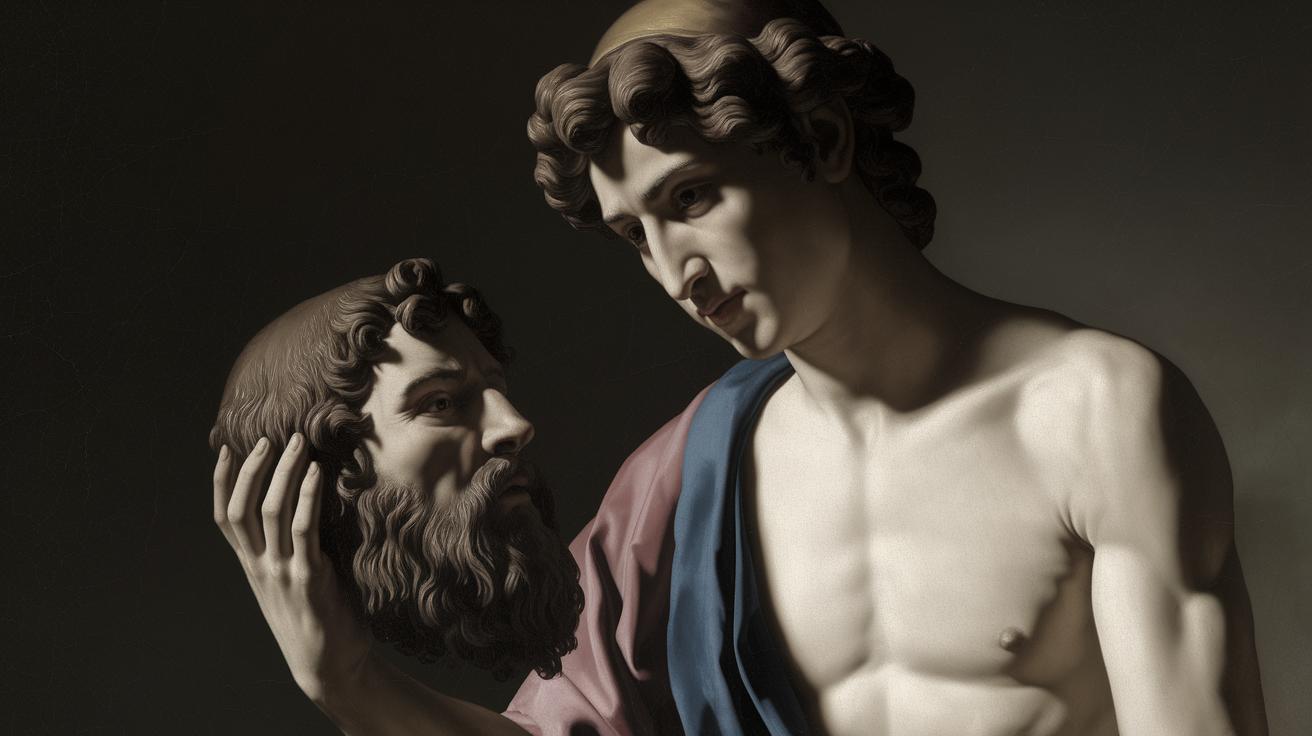
Exploring Caravaggio’s “David with the Head of Goliath”
Caravaggio’s “David with the Head of Goliath” is a masterpiece that brings to light the artist’s intricate use of light, shadow, and human emotion. This painting not only exemplifies the qualities of the Baroque period but also reflects Caravaggio’s personal battles with sin and redemption. Through our exploration, we will dive deep into the technical aspects, metaphorical elements, and emotional depth of the work. We will also draw parallels with nature and other artistic ventures, examining thumbnails, floral uniqueness, and foundational painting principles, to understand how these techniques pervade art through different mediums. Whether exploring the spontaneity of a bird’s sketch, the character of an iris, or the more classical forms, this discussion will furnish a comprehensive understanding of Caravaggio’s genius alongside broader artistic practices.
Technical Research
Caravaggio’s “David with the Head of Goliath” is a prime example of his mastery over chiaroscuro, a technique utilizing stark contrasts between light and dark. This method not only highlights the dramatic intensity of the painting but also serves as a vessel for Caravaggio’s personal turmoil. His choice of a young David and the mature, humbled Goliath intriguingly reflects the artist’s inner conflict between the innocence of youth and the corruption of adulthood. The painting further benefits from Caravaggio’s acute anatomical precision, and his rendering of human skin and facial expressions is meticulously lifelike.
Technically, Caravaggio’s brushwork demonstrates a blend of classical techniques with an emerging Baroque sensibility. Scholars have noted that Caravaggio might have employed the camera obscura, a tool that assists in accurate light projection onto a canvas, facilitating his unique approach to realism. Although this technique was controversial, it helped cement Caravaggio’s reputation as an innovator in the art world.
10-Minute Thumbnail Sketch Challenge: Birds
Thumbnail sketches are a quick and effective way to capture the essence of a subject or scene—a tool often utilized by artists like Caravaggio to plan larger compositions. Taking a cue from Caravaggio’s dynamic approach, one might engage in a 10-minute thumbnail sketch challenge focusing on birds, a subject full of motion and life. The objective is not to render them in detail but to capture the fluidity and inherent grace in their movements.
This rapid exercise enhances an artist’s ability to observe and translate real-life actions onto paper, an echo of Caravaggio’s ability to capture fleeting moments between light and shadow. Moreover, it enhances understanding of structure, balance, and form while increasing proficiency in conveying the natural dynamism found in both living creatures and dramatized human forms.
A Floral Spotlight: Each Iris Has Its Own Personality
Different flowers can often be likened to different subjects of art, each possessing unique characteristics much like the idiosyncratic figures in Caravaggio’s work. Irises stand out in the floral world with their distinct petals, varying hues, and intricate patterns. As with his figures, each iris can be rendered with personal traits, evoking diverse emotions and narratives through color and form.
Accentuating the distinct ‘personalities’ of irises requires an artist to delve deeply into their specific traits—a test of observational skill and patience. Analogous to Caravaggio’s meticulous attention to details in both foreground and background elements, capturing an iris’s essence encourages one to pay attention to aspects like light reflection, translucency, and shadow interplay, all crucial in drawing out the fullness of the subject.
Starting a Painting with Design and Values
Design and values serve as the backbone of any compelling piece of art. Caravaggio’s compositions are celebrated for their strategic placement of elements and the dramatic use of light to direct viewer focus. Initiating a painting involves establishing a solid structure through line sketches that lay the groundwork for value distribution.
Caravaggio’s paintings often convey a sense of movement and emotion through clever use of geometrical principles and calculated asymmetry. Artists today can draw inspiration from this, beginning with loose sketches that plot the design while adjusting value placements to create depth and narrative tension. Balancing lighter and darker elements not only emphasizes contrast but also creates a harmonious visual rhythm, much like Caravaggio’s interplay between divine light and earthly darkness.
Indicate, Don’t Illustrate
The principle of ‘indicate, don’t illustrate’ resonates with Caravaggio’s ability to conjure emotions through suggestion rather than explicit depiction. In “David with the Head of Goliath,” Caravaggio’s economical use of detail not only encourages viewer engagement but also invites personal interpretation—key ingredients for an artwork that transcends mere visual storytelling.
This approach can also be applied to other media, where suggestive elements hint at broader stories or emotions without spelling them out. For example, an artist might depict a bird in flight not with meticulous feathers but through intentional lines and shadows that imply movement and grace. This methodology enriches narratives, offering layers that only the viewer’s imagination can unravel fully.
Painting of the Week: “Old Copper and Fruit”
“Old Copper and Fruit” marries the rich tonal quality reminiscent of Caravaggio’s work with ordinary objects, inviting viewers to find beauty in life’s mundanities. The painting’s use of light replicates a deference for the kind of dramatic chiaroscuro that Caravaggio mastered, where copper and fruit become engaging subjects through skillful contrasts.
In this piece, the aged patina of copper provides a rustic background, strikingly juxtaposed with the lushness of fresh fruit—demonstrating how texture influences perception. Such paintings bring forth a tactile experience, as the observer mentally engages with both the visual and the imagined sensory elements, reflecting the same expressive potency Caravaggio injected into all his masterpieces.
Future Prospects
| Subheading | Summary |
|---|---|
| Technical Research | Explores Caravaggio’s technique, use of chiaroscuro, and personal reflections in the painting. |
| 10-Minute Thumbnail Sketch Challenge: Birds | Discusses the importance of quick sketching to capture movement, akin to Caravaggio’s dynamic compositions. |
| A Floral Spotlight: Each Iris Has Its Own Personality | Highlights the individuality of subjects in art, paralleling the distinctive elements in Caravaggio’s portraits. |
| Starting a Painting with Design and Values | Examines foundational strategies in artwork similar to Caravaggio’s structured and value-rich compositions. |
| Indicate, Don’t Illustrate | Focuses on suggestive artistic techniques that engage the viewer’s imagination, as demonstrated by Caravaggio. |
| Painting of the Week: “Old Copper and Fruit” | Presents a modern homage to Caravaggio’s style with everyday subjects, showcasing light and texture. |

