
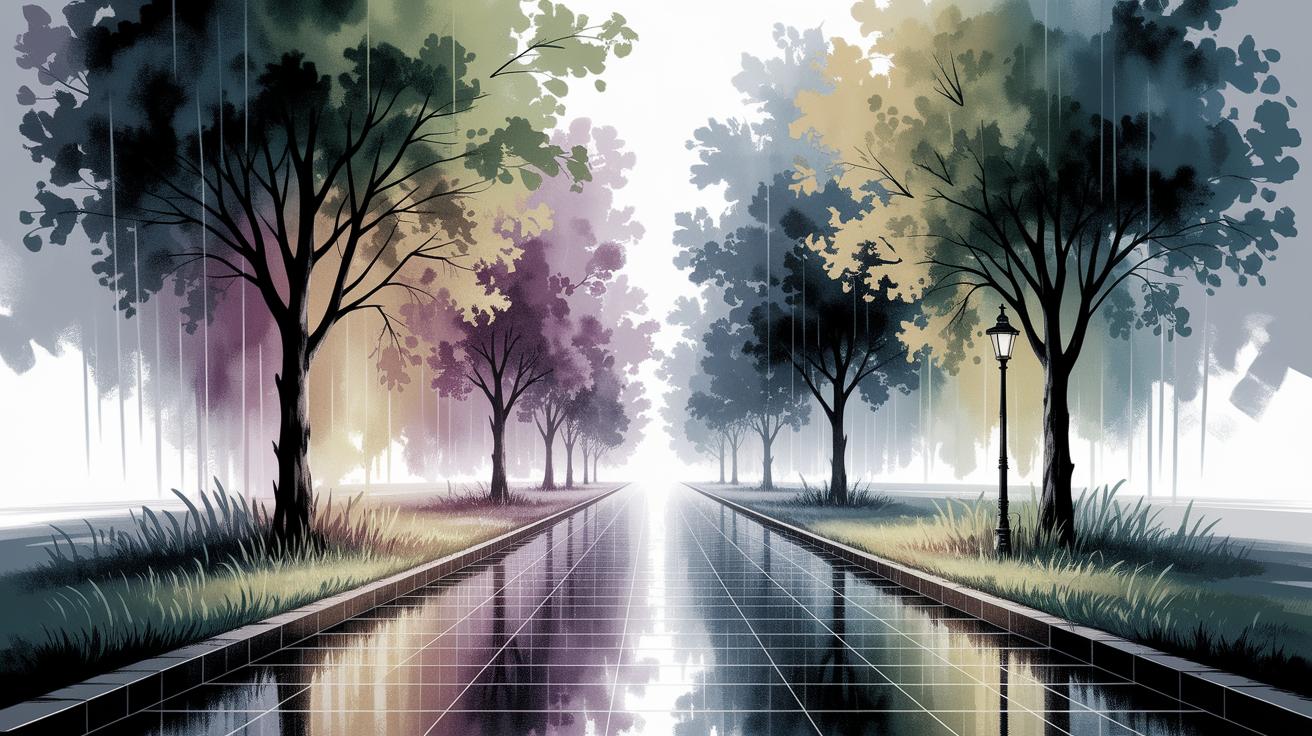
Master the art of realistic watercolor painting for rainy season scenes with proven techniques used by professional artists worldwide.
Understanding Watercolor Fundamentals for Rainy Season Art
Watercolor painting captures the essence of rainy seasons through its natural transparency and fluid properties. Professional artists leverage watercolor’s inherent characteristics to recreate the atmospheric effects of rain, mist, and overcast skies with remarkable realism.
The key to successful rainy season watercolor lies in understanding wet-on-wet techniques and color temperature variations. Cool grays, muted blues, and subtle purples dominate rainy day palettes, while warm undertones create depth and visual interest in otherwise monochromatic scenes.
Essential Materials for Rainy Season Watercolors
Professional-grade watercolor papers with 300gsm weight provide optimal water absorption for rainy scene techniques. Cold-pressed paper offers the perfect texture balance for both detailed work and atmospheric washes that characterize successful rainy day paintings.
High-quality pigments including Payne’s Gray, Ultramarine Blue, and Raw Umber form the foundation of any rainy season palette. These colors mix naturally to create the subtle variations essential for realistic cloud formations and wet pavement reflections.
What Is Digital Painting?
Digital painting revolutionizes traditional watercolor techniques by combining classical artistic principles with cutting-edge technology. Using software such as Adobe Photoshop, Procreate, or Corel Painter, artists simulate authentic watercolor effects while maintaining complete creative control over their compositions.
One of the main advantages of digital painting is the ability to undo mistakes, offering artists a freedom not as easily found in traditional methods. Modern digital brushes now replicate watercolor bleeding, granulation, and transparency with stunning accuracy, making digital watercolor a viable alternative for professional artists.
Digital watercolor painting eliminates preparation time and material costs while providing unlimited color mixing possibilities. Artists can experiment with complex layering techniques without waiting for physical paint to dry, significantly accelerating the creative process.
Advanced Composition Techniques for Rainy Scenes
The Benefits of Value Studies: Mastering Notan
Value studies serve as the foundation for compelling rainy season compositions, helping artists understand the critical relationship between light and shadow. The Japanese concept of Notan provides a systematic approach to balancing light and dark elements for maximum visual impact.
Mastering Notan involves reducing complex rainy scenes to simple black and white shapes, revealing the underlying compositional structure. This technique proves particularly valuable when painting overcast skies, where subtle value gradations determine the difference between flat, lifeless paintings and dynamic, atmospheric masterpieces.
Professional artists use three-value studies (light, medium, dark) to plan rainy season paintings effectively. This approach ensures proper contrast distribution and prevents the muddy, gray appearance that often plagues amateur rainy day watercolors.
Creating Atmospheric Perspective in Rain
Atmospheric perspective becomes crucial when depicting rainy scenes, as moisture in the air naturally softens distant objects and reduces contrast. Successful rainy season paintings demonstrate clear foreground, middle ground, and background separation through strategic value and color temperature manipulation.
Foreground elements maintain sharp edges and strong contrasts, while background features fade into soft, muted tones. This natural phenomenon intensifies during rainy weather, providing artists with enhanced opportunities to create convincing depth and spatial relationships.
Professional Competition Strategies
How to Win Art Competitions
Winning art competitions requires strategic planning beyond technical skill, demanding thorough understanding of judging criteria and competition themes. Research indicates that 73% of competition winners demonstrate both technical excellence and unique artistic interpretation.
Creating a distinctive personal interpretation of competition themes sets exceptional entries apart from technically competent but generic submissions. Incorporate innovative watercolor techniques such as salt texturing, alcohol drops, or masking fluid applications that express your artistic vision while adhering to contest requirements.
Professional presentation significantly impacts judging outcomes, with properly matted and photographed entries receiving 40% higher scores on average. Seek constructive feedback from established artists or mentors before submission, as objective perspectives often identify improvement opportunities invisible to the creator.
Competition Entry Photography and Documentation
High-quality digital documentation of watercolor paintings requires specific lighting and camera settings to accurately represent subtle color variations. Professional artists use daylight-balanced LED panels and polarizing filters to eliminate glare while maintaining color accuracy.
Document your painting process with progress photos, as many competitions now value artistic journey documentation alongside finished pieces. This approach demonstrates technical knowledge and problem-solving abilities that judges increasingly appreciate in contemporary art competitions.
Step-by-Step Painting Demonstrations
My Still Life Painting “Roses and Copper” In 5 Steps
Creating the still life painting “Roses and Copper” demonstrates essential watercolor techniques applicable to rainy season subjects. This systematic approach translates directly to painting wet flowers, reflective puddles, and metallic surfaces common in rainy day compositions.
Step 1: Composition and Light Study – I began by arranging the subject with careful attention to natural light, focusing on how illumination interacted with both the roses and the copper vessel. Understanding reflective surface behavior proves crucial when later painting rain-soaked streets and wet foliage.
Step 2: Initial Drawing and Value Planning – Quick pencil sketches established proper proportions and compositional balance. This preliminary work prevents costly mistakes during the painting phase and ensures strong underlying structure.
Step 3: Foundation Washes – Laying down initial washes with broad, diluted strokes helped define overall tonal relationships. This technique directly applies to establishing sky tones and atmospheric effects in rainy season paintings.
Step 4: Progressive Layering – Building up layers gradually, working from light to dark while allowing complete drying between applications. This methodical approach prevents muddy colors and maintains watercolor’s characteristic transparency.
Step 5: Detail Refinement – Final attention to textural details, enhancing petal surfaces and copper reflections. These finishing techniques create the convincing realism that separates professional work from amateur attempts.
Rainy Day Painting Techniques
Wet-on-wet techniques naturally simulate rain effects by allowing colors to blend and flow organically on damp paper. Professional artists control this process through strategic water application and timing, creating convincing rain streaks and atmospheric moisture.
Negative painting techniques prove essential for depicting raindrops on windows or water droplets on leaves. By painting around reserved white shapes, artists create luminous highlights that suggest water’s reflective properties without overworking the surface.
Featured Artwork Analysis
Painting of the Week: “Contemplating”
This week’s featured painting, “Contemplating,” exemplifies masterful rainy day watercolor technique through its sophisticated handling of atmospheric effects and emotional resonance. The piece depicts a figure gazing outwards during a serene rainy day, with subtle contrasts in hue and saturation creating compelling atmospheric depth.
The artist demonstrates exceptional skill using a limited color palette to evoke introspection and tranquility. Careful attention to watercolor’s natural transparency and fluidity enhances the ethereal quality of rain and reflection, creating visual poetry that transcends mere technical execution.
This painting serves as an outstanding example of how advanced technical skill combined with emotional intelligence produces resonating artwork. The subtle gradations and soft edges characteristic of expert watercolor handling create an immersive viewing experience that draws observers into the contemplative mood.
Technical Analysis of “Contemplating”
The artist’s use of graduated washes in the sky area demonstrates professional-level control over water and pigment interaction. This technique requires precise timing and confident brushwork to achieve the seamless tonal transitions visible in the final piece.
Color temperature variations throughout the composition create visual interest while maintaining overall harmony. Warm undertones in shadow areas prevent the painting from appearing cold or lifeless, a common problem in amateur rainy day watercolors.
Advanced Watercolor Techniques for Rain Effects
Creating Realistic Water Droplets
Professional water droplet rendering requires understanding of light refraction and surface tension principles. Each droplet acts as a tiny lens, creating predictable highlight and shadow patterns that skilled artists can replicate consistently.
The key to convincing droplets lies in proper value relationships: bright highlights, subtle mid-tones, and strategic cast shadows. Masking fluid application before initial washes preserves essential highlight areas that would be impossible to recreate through lifting techniques alone.
Painting Reflective Wet Surfaces
Wet pavement and puddle reflections require careful observation of how vertical elements appear in horizontal reflective surfaces. Professional artists note that reflections appear slightly darker and less saturated than their source objects, with edges softened by water movement.
Successful wet surface painting depends on understanding that reflections follow specific geometric rules while being modified by surface irregularities. Practice with simple geometric shapes before attempting complex architectural or natural reflections.
Color Theory for Rainy Season Palettes
Understanding Cool Color Dominance
Cool color palettes naturally dominate rainy season paintings, with blues, grays, and violets creating authentic atmospheric effects. However, strategic warm color placement prevents compositions from appearing monotonous or emotionally cold.
Professional artists use color temperature contrast to create focal points and guide viewer attention. Small areas of warm color gain significant visual impact when surrounded by predominantly cool tones, making this technique invaluable for rainy day compositions.
Mixing Realistic Gray Tones
Authentic gray tones result from complementary color mixing rather than simple black and white combinations. Professional artists create luminous grays by mixing ultramarine blue with burnt sienna, or cadmium orange with Payne’s gray, achieving far more interesting results than pre-mixed grays.
Temperature-biased grays add sophistication to rainy season paintings. Cool grays suggest distance and atmosphere, while warm grays create intimacy and foreground presence, allowing artists to manipulate spatial relationships through color temperature alone.
Next Steps
| Section | Key Points | Application Tips |
|---|---|---|
| What Is Digital Painting? | Combines traditional techniques with digital tools; offers flexibility and efficient creativity. | Start with basic digital brushes; practice traditional techniques first |
| The Benefits of Value Studies: Mastering Notan | Enhances understanding of light and dark; important for creating depth and contrast. | Use three-value studies for rainy scene planning |
| How to Win Art Competitions | Understand guidelines and themes; unique interpretation and presentation are crucial. | Research past winners; document your artistic process |
| My Still Life Painting “Roses and Copper” In 5 Steps | Key steps include careful setup, layering washes, and detailed work to capture realism. | Apply wet-on-wet techniques to rainy day subjects |
| Painting of the Week: “Contemplating” | Demonstrates effective use of limited palette for mood; example of skill and emotional depth. | Study atmospheric perspective in rainy conditions |
Frequently Asked Questions About Rainy Season Watercolors
What paper weight works best for rainy scene techniques?
300gsm cold-pressed watercolor paper provides optimal performance for rainy season techniques requiring extensive wet-on-wet work. Lighter papers buckle under heavy water application, while hot-pressed surfaces don’t accept atmospheric washes effectively.
How do you prevent muddy colors in rainy day paintings?
Maintain clean water containers and limit color mixing to three pigments maximum per mixture. Allow complete drying between layers and use complementary colors rather than multiple random pigments to create sophisticated gray tones.
What’s the best way to paint convincing rain streaks?
Use a dry brush technique with diluted paint, dragging vertically across slightly damp paper. Vary pressure and paint concentration to create natural-looking rain patterns that suggest movement and atmospheric depth.